Enterprise SaaS · Post-Sale Operations Platform
Concept
A solo, 7-week concept for the handoff moment that decides whether a new customer starts strong.
Quick facts
Company
RelayOS
a concept enterprise post-sale operations platform
My role
Full concept-to-MVP
research, product strategy, UX/UI design, prototyping
Team
Solo project
Timeframe
7 weeks
Status
Concept project
not built or shipped
The problem
Sales considers the deal finished. Delivery is only just getting started.
Business problem
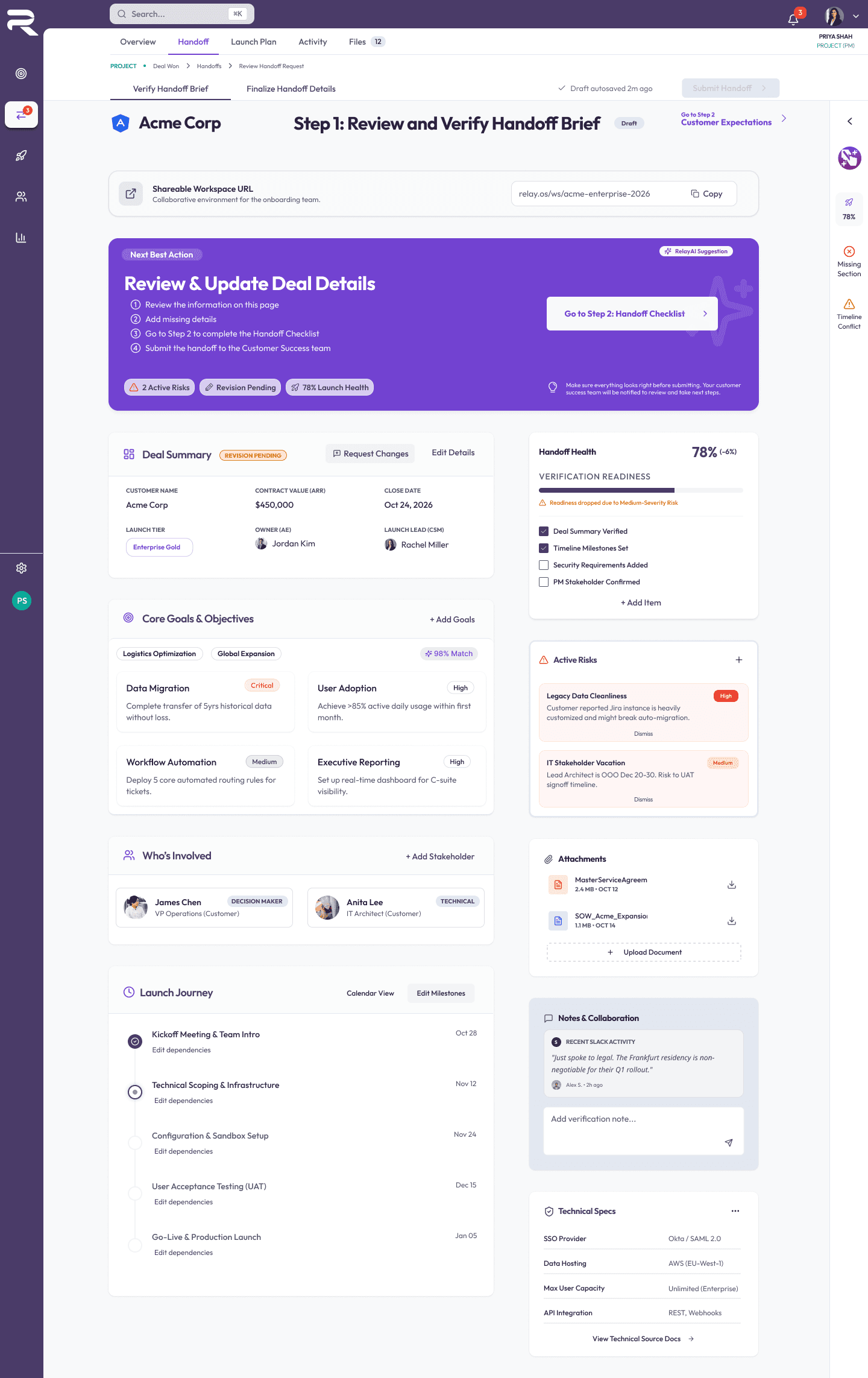
When a deal closes, the context behind it (what was promised, who owns what, what the customer expects) scatters across CRM notes, Slack threads, and institutional memory. Sales considers the deal finished, while Delivery is just getting started. That gap makes customer launches slower and more error-prone. No platform on the market owns this transition.
User problem
Delivery teams inherit deals without the context that closed them, and have no shared place to establish ownership or track what’s still outstanding before kickoff.
Constraints
3-week solo concept sprint
No access to real enterprise Sales or Delivery teams
Needed to define a focused MVP within a broad problem space
How I got there
Moving fast solo, then checking my own findings against real people.
Because I was working solo, in three weeks, without access to real enterprise Sales and Delivery teams, I built my research in two stages: an AI-generated synthetic user round to move fast and stress-test direction, followed by real moderated testing to validate it.
Competitive audit and industry research
Synthetic participants with insights based on recurring themes from public discussions in Reddit threads, online newsletters, and YouTube videos (not presented as real user research)
Affinity mapping, personas, and empathy storyboarding built from those synthetic findings
Simulated testing sessions against uploaded wireframes, with participants modeled after the same primary personas
Real validation
Moderated usability testing with real people, used specifically to confirm or correct what the synthetic round suggested
AI-generated findings were treated as directional, never conclusive, until checked against this round
KEY FINDING
That shifted the project from designing another CRM feature to designing the handoff between Sales and Delivery. That gap became the strategic bet: build the system that makes launch readiness as visible and accountable as pipeline.
The decisions
Three calls, each with a real trade-off attached.
01
Focused the MVP on the customer handoff
RelayOS could have become a CRM, a PM tool, or a full customer success platform, and would have diluted into a weaker version of all three. I scoped the MVP to a single high-leverage moment: the handoff from Sales to Delivery. Every feature (the workspace, the scoring, the AI summaries) exists to serve that one transition well, not to compete on feature breadth.
02
Helped teams decide what to do next
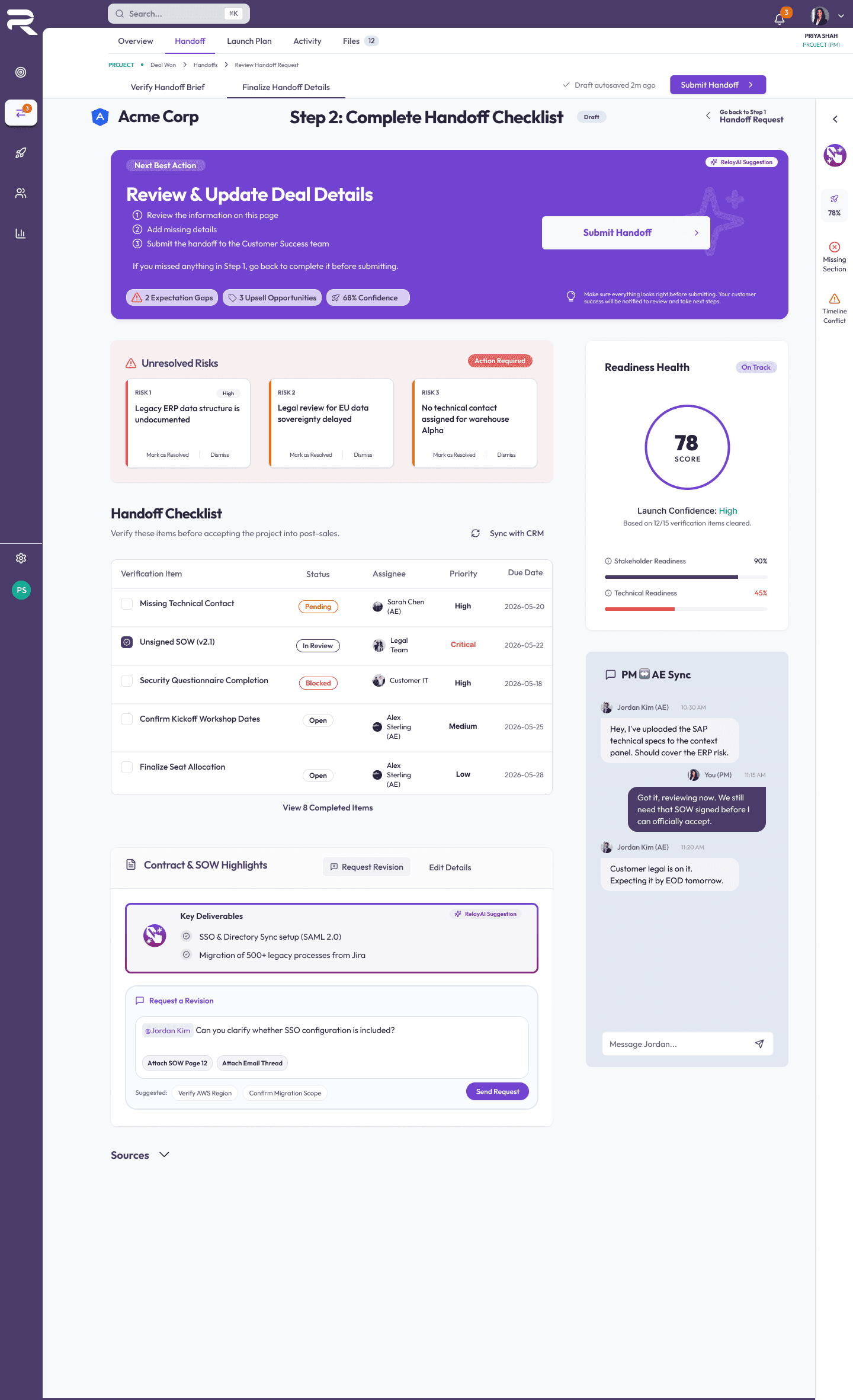
Both the synthetic and real testing rounds surfaced the same problem: users could understand the product but not act on it. They scanned dashboards and asked, “What should I do next?” I deprioritized secondary analytics and expansion-opportunity surfacing in favor of Next Best Action guidance. The product’s job shifted from reporting status to directing outcomes.

03
Kept familiar navigation, changed the workflow
I initially wanted to reinvent CRM navigation outright. Research pushed back: enterprise users trade novelty for speed and predictability. I kept RelayOS’s structure close to patterns users already trust, and put design effort where the actual gap was: expectation alignment, context preservation, and risk visibility.

AI as a research tool, not the story
Used AI to move fast under a hard constraint, not to make the calls.
Working solo in three weeks meant I didn’t have access to real enterprise Sales and Delivery teams to interview directly, so I used ChatGPT and Gemini to construct a synthetic participant set grounded in real, public enterprise-SaaS discourse, and used that set to run simulated interviews, a focus group, and an initial usability pass against my wireframes.
I treated every synthetic finding as a hypothesis, not a fact, and validated the ones that mattered most through real moderated usability testing before locking design direction. AI accelerated exploration; it didn’t replace judgment or make the final calls.
Results
Because this is a concept project, these are targets I’d track, not production results.
Directional · hypothesized, not measured
20–30%
Reduction in days from Closed Won to kickoff
15–20%
Reduction in time-to-value
40%
Reduction in missing-information incidents at handoff
90%
Target handoff completion rate
North Star

Reflection
The strongest version of this product wasn’t the most feature-complete one. It was the narrowest. I started this project assuming the challenge was designing another enterprise platform. By the end, the harder design problem was deciding what not to build.
What I’d do differently
If I revisited the project, I’d recruit Sales and Delivery teams earlier so the personas and success metrics reflected real organizational workflows instead of directional research. The synthetic research was a reasonable way to move fast under a hard deadline, but the product deserves pressure-testing against real handoff data before I’d trust them past the concept stage.
Michael Cowen · Product Designer
© 2026 · Michael Cowen · Product Designer